

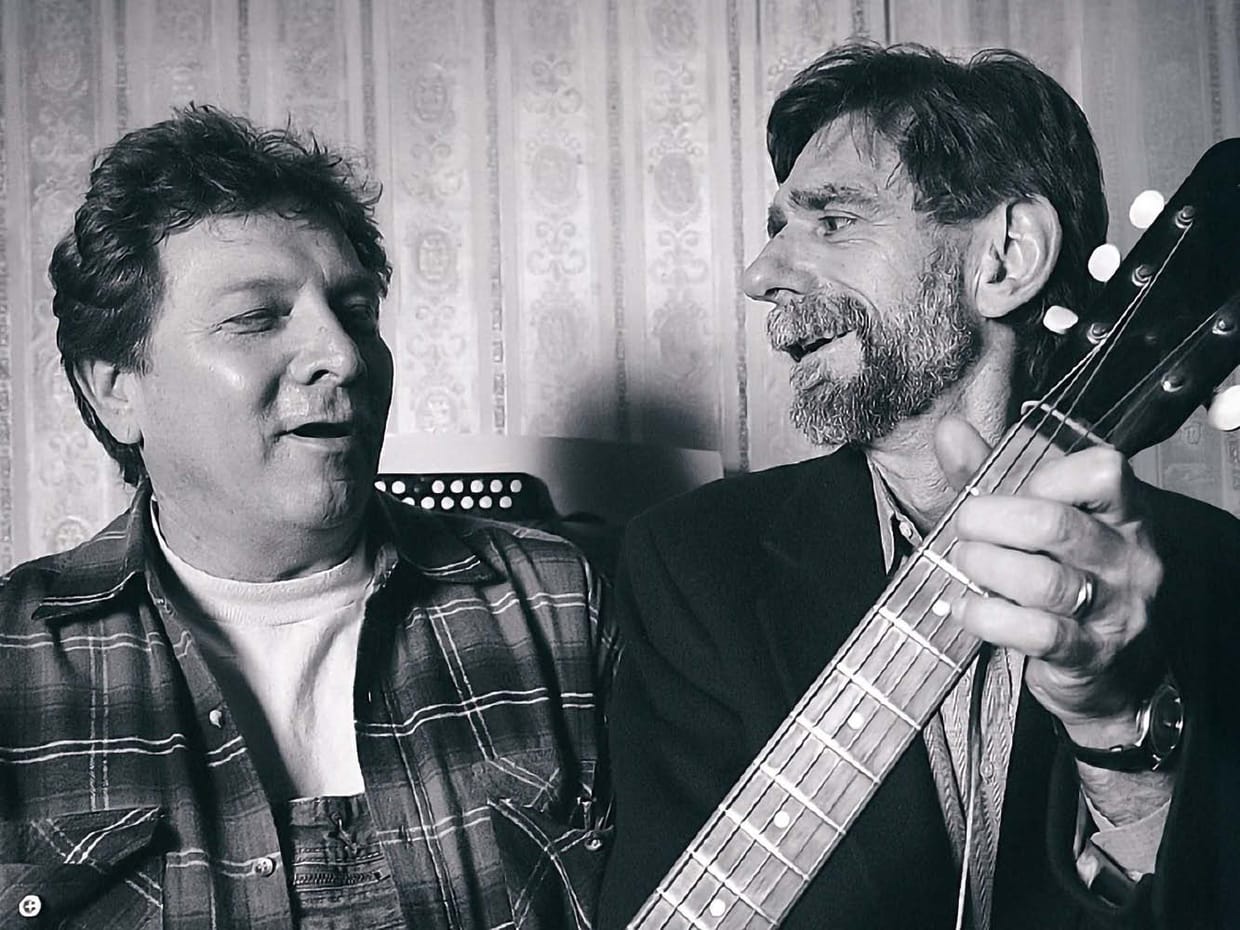
CW Dan Penn + Spooner Oldham
City Winery Nashville Presents Dan Penn + Spooner Oldham on Sunday, January 18th at 7:30 PM!
At first glance, Dan Penn, a self-professed hillbilly from Alabama, may seem like an unlikely candidate for one of soul music’s greatest creative forces. Nevertheless, when considering the vital role he played in the development of soul music in both Muscle Shoals and Memphis, no other distinction is possible. During a career spanning over six decades, Penn has left an indelible mark on popular music as an iconic songwriter, a fearless producer, and a criminally underrated singer, merging the worlds of black R&B and white country music with a rarified expertise.
Born Wallace Daniel Pennington in Vernon, Al., Penn was entranced with Southern regional music from an early age. Although both of his parents were musically inclined, Penn’s true musical awakening came when listening to Nashville station WLAC. “They were playing strictly black stuff, spirituals, R&B,” he recalled. “My ears just told me what was good. That was the start of it. And I kept learning that way.” As a teenager, Penn moved to the Florence/Muscle Shoals area, where he became the lead vocalist for local R&B band “The Mark V Combo,” and later with the grittier “Dan Penn and the Pallbearers.” In short order, Penn and his bandmates would become the initial core of Alabama’s flourishing music industry.
In 1960, Penn gained his first taste of success by writing a tune called “Is a Bluebird Blue?” which became an early hit for Conway Twitty. “I remember being flabbergasted. It just didn’t seem possible. That song opened doors to me my whole career,” he said. Penn also began working at SPAR Music studio, an upstart studio founded by Rick Hall and Billy Sherrill located above a drugstore. “We went up these stairs, it’s twelve o’clock noon, and we knocked on this door,” Penn recalled of his initial visit. “They opened the door, and there were three or four big beds in there, and they were full of guys sleeping at noon. I said, ‘This is my place.’”
When Rick Hall broke with Stafford to open his own studio, which he called FAME (Florence Alabama Music Enterprise), Penn followed and became the studio’s first resident songwriter. He also continued to play the fraternity circuit with the Pallbearers, until the band left en masse for Nashville in 1964. With his bandmates gone — and with FAME now missing most of its studio band — Penn faced a period of soul searching. He recalls staring at the studio from his car and thinking “That’s not only a door, that’s the door.” Determined as ever to find success in the music industry, Penn largely abandoned his ambitions as a musician and focused instead on honing his skills as a writer and producer. “That’s what I’m gonna be; I’m gonna be a studio cat,” he recalls telling himself.
As a new crop of musicians began to make their way to FAME, Penn soon began writing alongside keyboardist Spooner Oldham, a partnership that would prove to be one of the most formidable of the decade. Over the next few years, the duo composed scores of excellent southern soul tunes, including Percy Sledge’s “It Tears Me Up,” James and Bobby Purify’s “I’m Your Puppet,” and Joe Simon’s “Let’s Do It Over,” his first significant R&B hit. Despite these successes, Penn began to feel constrained at FAME, especially regarding his inability to produce records. When producer Chips Moman invited him to join his team at American Sound Studio in Memphis, he gladly accepted.
Almost immediately, the newfound partnership between Dan Penn and Chips Moman proved to be extremely fruitful. In 1966, the duo co-penned the smoldering cheating anthem “The Dark End of the Street,” a huge hit for singer James Carr that the city’s Commercial Appeal newspaper announced as Memphis’ all-time greatest soul song. High praise in a soul city! Soon after, they co-wrote another soul standard with “Do Right Woman, Do Right Man,” an early hit for Aretha Franklin that Jerry Wexler called “perfection.” Having already proven his immense worth as a songwriter, Penn was now ready to take a stab at production. “Me and Moman had tried to produce some records together, but I was having a pretty hard time getting my ideas across,” he said. “So I told him, ‘I want to produce a record and I want to do it my way and I want to do it by myself.’”
In 1967, Penn was given his first shot at producing when a young blue-eyed soul group called the Box Tops arrived at American Sound Studio. Penn had a song called “The Letter” from writer Wayne Carson Thomas in his pocket, which he felt would be a good fit for the band and their sixteen-year-old singer Alex Chilton. “They came Saturday morning around ten o’clock and they had Alex Chilton with them, who I’d never seen,” Penn recollected. “We started running ‘The Letter’ down, and he sounded pretty good. I coached him a little, not much, told him to say ‘aer-o-plane,’ told him to get a little gruff, and I didn’t have to say anything else to him.” Despite the odds, “The Letter” became a number one hit and one of the biggest songs of 1967, solidifying Penn as a natural producer and Chilton as a certified star. Over the next year, Penn continued to work with the band, even reuniting with his writing partner Spooner Oldham to write their second major hit song “Cry Like a Baby,” a million-seller which he also produced.
Although he had reached a career pinnacle with the Box Tops, Penn’s passion and focus remained with the creating of black music with black artists. Tragically, Memphis’ golden era of racial unity amongst musicians would be forever altered on April 4, 1968 with the assassination of Dr. Martin Luther King, Jr. “It changed my life,” Penn lamented. “Suddenly, whatever it was that we had with black people was gone. I mean, we were basically country boys cutting black records. That’s what made it sound like it did…so it changed all of our lives, Martin Luther King’s death.” While his writing partner Spooner Oldham departed for Los Angeles, Penn remained in Memphis, distraught and disheartened. “I went off on a big soul-search. I didn’t have a co-writer, I didn’t have black artists. I loved black music. It’s all I thought about, it’s all I did.”
After departing from American Sound, Penn established his own studio in Memphis called Beautiful Sounds. While the studio ultimately proved unsuccessful, it was there that he wrote the song “A Woman Left Lonely,” which later appeared on Janis Joplin’s classic album “Pearl,” as well as his own fine solo album “Nobody’s Fool.” In the mid-1970s, Penn and his wife relocated to Nashville. Once arriving, he continued to write for artists such as Ronnie Millsap and Johnny Rodriguez, although he was never fully able to embrace the city’s country music scene. “I appreciate Nashville, it’s a good city to live in…but you know, I’ve never really been a big fan of the Nashville sound, I have to say,” he once told NPR.
In 1991, Penn reunited with Spooner Oldham for an appearance at the New York Bottom Line’s “In Their Own Words” songwriter series, a live performance of original songs that inspired him to record a new album. In 1994, he released his second solo album “Do Right Man,” a critically acclaimed album that AllMusic said proves “The man deserves to be an American musical icon.” He followed up the album with a world tour alongside Oldham, which yielded the excellent live collection Moments from This Theater. In 2013, Penn was inducted into the Alabama Music Hall of Fame, later appearing in the film Muscle Shoals, a hit documentary that introduced a new generation to the music of FAME Studios. Today, nearly 60 years after he began his career, Dan Penn continues to write and perform, although he no longer thirsts for that elusive hit song, haven already proven himself time and again. “Tell you the truth, I just write for myself. I still write pretty much like I did back then, other than the fact that I don’t stay up all night. I do get some sleep nowadays.”
Spooner Oldham is a singer, songwriter, multi-instrumentalist, and a key contributor to the development of Southern soul music and countless pop, rock, country, and R&B recordings.
He was born Dewey Lindon Oldham, Jr. on June 14, 1943 in Sheffield, Alabama, and grew up in the unincorporated community of Center Star in Alabama’s northern Lauderdale County. Spooner Oldham came from a musical family. His father, Dewey Lindon Oldham Sr., formed a string band with Spooner and his brothers, taught Spooner chords on the mandolin (that Spooner transposed to guitar) and created an original Southern gospel style. Spooner’s early influences included singing in church and listening to the Grand Ole Opry on the radio. Oldham Sr.’s band recorded a record at WJOI in Florence, AL and auditioned for the Grand Ole Opry in the early 1940s. Oldham, Sr. might have turned professional were it not for his father’s World War II-related disability. Spooner was given a piano as a youth, and his mother, Marie, a hair stylist, and his two sisters, Judy and Donna, also sang. Donna had a brief stint in a rock band.
He acquired his nickname literally by accident. When he was four years old, while reaching for a pan on the kitchen stove, he dislodged a spoon that struck him in the face, damaged his retina, and ultimately cost him the sight in his right eye. Years later he told the story to a fifth-grade friend, who began calling him Spooner, and the nickname stuck.
During his time in junior high school, Oldham took piano lessons which led him toward Dixieland jazz. He became the keyboardist in a local rock ‘n’ roll and rhythm & blues band called Hollis Dixon & the Keynotes. He attended Alabama’s State Teachers College from 1961 to 1962, and often spent time hanging around Tom Stafford’s small studio and publishing company located over the City Drug Store in Florence. His interest in playing R&B and rock & roll drew him towards fellow musicians such as Rick Hall and Billy Sherrill. When Dan Penn arrived in Florence, the two became fast friends and started writing music together… a friend who would help shape Southern music. His early career was closely tied to the Muscle Shoals music scene, where he played a significant role in shaping the region’s distinctive sound.
After a short stint at Spar Music, Oldham’s professional musical journey began at Rick Hall’s iconic FAME Studios in Muscle Shoals, where he contributed to numerous hit records. Along with other Muscle Shoals Rhythm Section session players (who became known as The Swampers), Spooner conducted musical experiments that gave birth to what is now called the Muscle Shoals Sound. This happened in the early 1960s as R&B was shifting towards a smoother pop sound, influenced by the emerging Motown Sound from Detroit. Meanwhile, popular rock n’ roll was also undergoing changes at the time.
Oldham’s keyboard work from Muscle Shoals can be heard on timeless classics like Percy Sledge’s “When a Man Loves a Woman,” Wilson Pickett’s “Mustang Sally,” and Aretha Franklin’s “I Never Loved a Man (The Way I Love You),” showcasing his talent for blending gospel, blues, and soul influences into a unique and compelling sound. These are enduring songs that have stood the test of changing musical trends in the late 60s – and one common factor among them was the smooth keyboard sound, thanks to Spooner Oldham. With so many hits emerging from Muscle Shoals, thanks in large part to the musical mastery of Oldham, record executives like Atlantic’s Jerry Wexler beat a path to north Alabama. Aside from Pickett, Franklin and Sledge, Spooner also played on albums by Etta James, Clarence Carter, Jimmy Hughes and others.
In the late 1960s, Oldham moved to Memphis, where he teamed up again with friend and songwriter Dan Penn at Chips Moman’s American Studios. Together, they wrote hits including “I’m Your Puppet” for James and Bobby Purify and “Cry Like a Baby” for The Box Tops, on which Oldham played organ. It was with The Box Tops that Spooner and fellow songwriter Dan Penn found national success, significantly contributing to the Memphis music scene. This partnership blended the soulful sounds of Muscle Shoals with the gritty, raw energy of Memphis. They also wrote “A Woman Left Lonely” for Charlie Rich (later covered by Janis Joplin), and “Take Me (Just As I Am)” for Spencer Wiggins, which Solomon Burke also recorded. Some say that the effects and impact of the 1968 assassination of Dr. Martin Luther King may have led to Oldham’s departure from Memphis.
Oldham’s influence extended beyond Memphis as he later moved to Los Angeles, where he continued to be a sought-after session musician. His versatility and talent made him a valuable collaborator in various musical genres. He worked with a wide range of artists across the stylistic spectrum, including Arlo Guthrie, Jim Croce, Gram Parsons, The Everly Brothers, Jackson Browne, Linda Ronstadt, Gene Clark, Ry Cooder, The Flying Burrito Brothers, Delaney and Bonnie Bramlett, Bob Seger, Maria Muldaur, Rita Coolidge, Bobby Womack, Albert King, Helen Reddy, Harry Nilsson, Stephen Stills, J.J. Cale, and others.
In the late ‘70s, Oldham moved to Nashville and began collaborating with Neil Young. Oldham played the keyboard on Young’s 1978 album “Comes a Time” and continued to work with Young on other albums such as “Old Ways,” “Harvest Moon,” “Silver & Gold,” and “Prairie Wind.” This collaboration led to Oldham touring extensively with Young’s International Harvesters band. Additionally, Oldham supported Bob Dylan during his Christian era, contributing to Dylan’s “Saved” album and joining the Saved and Shot of Love Tours. With Dylan, he played 79 shows, appeared on Saturday Night Live and on that year’s Grammy Awards telecast. Oldham also partnered with John Prine for the 1984 album “Aimless Love” and appeared on Prine’s 1994 release “A John Prine Christmas.” When Crosby, Stills, Nash & Young reunited for their “Freedom of Speech Tour,” Oldham offered keyboards.
Throughout the ‘80s, Oldham worked as a sideman and collaborated with Steve Wariner on the song “Lonely Women Make Good Lovers.” In 1991, Oldham and Penn reunited for a performance at New York’s Bottom Line, reigniting their partnership. They contributed to Arthur Alexander’s 1993 album “Lonely Just Like Me.” In the late 1990s, Oldham and Penn reunited for a hugely embraced acoustic tour throughout parts of the U.S., Europe, Australia and Japan. From this tour, a soulful, stripped-down live album titled “Moments From This Theater” was released in 1999.
Active as a performer in his own right, Oldham continued to work as a session musician. His most notable credit of the ‘90s was Jewel’s album “Pieces of You,” which produced the smash hit “Who Will Save Your Soul.” In the 2000s, he continued to play with a diverse group of musicians. He appeared on a pair of Frank Black albums in the mid-2000s, joined the Drive-By Truckers for their 2007 The Dirt Underneath tour, and played with Amos Lee, Aaron Neville, Bettye LáVette and Cat Power in 2008.
Throughout his career, Oldham has been recognized for his contributions to music. In 2008, he was inducted into the Musicians Hall of Fame in Nashville and shortly afterward in 2009, he was inducted into the Rock and Roll Hall of Fame in the “Sideman” category. In 2013, he was inducted into the Birmingham Record Collectors Hall of Fame and in 2014, to the Alabama Music Hall of Fame. Oldham played on Keith Richards’ 2015 album “Crosseyed Heart” and Sheryl Crow’s 2019 album “Threads.” He also appeared on “Dark in Here,” the 2021 album by the Mountain Goats. In 2024, he teamed with the Scottish band, Texas, for “The Muscle Shoals Sessions” album, a collection of soul covers the Scottish band recorded at FAME Studios.
His legacy is marked by his ability to seamlessly blend different musical styles and his significant impact on the sound of American soul and rock music. Spooner Oldham’s association with Memphis music is a testament to his adaptability and talent. By bringing his Muscle Shoals experience to Memphis, he helped create a rich, soulful sound that continues to influence musicians today.